Bluesky started its life as an alternative to the ‘enshittifying’ of Twitter: bots, fascism, and AI becoming commonplace, making the site harder, some even saying impossible, to use. So, for the starting point of blocking misinformation, the ‘easy’ part is the fact that the people making Twitter worse stayed there because they were happy, while everyone who was disgusted and annoyed left to head to Bluesky, which meant that most of the people deliberately spreading lies were already out of the way. Of course, simply leaving a toxic space doesn’t inherently make a site misinformation-free. Bad actors can always slip into a space, after all. But there is an inherent cushion coming from its current reputation as A More Left-Wing Space Than Twitter. People trying to pander to the right wing, or grift, naturally gravitate to Twitter more because Bluesky is still a bit smaller and newer, compared to Twitter’s “long”, “industrious” history.
NAFO (a moderately informal organization dedicated to combating misinformation from Russian agents/forces and assisting with the situation in Ukraine) took an opportunity to examine how Bluesky’s smaller nature and user-led moderation efforts can leave it open to weaknesses when it comes to the spreading of misinformation overall. The author of the article does make a point that user-led efforts to ban bots and get rid of misinformation from duplicate accounts are doing a good job, just that the owners of the site could be doing more both themselves and to strengthen the tools said ‘unofficial mods’ can use to do so. But there’s also the fact that the decentralized approach is part of Bluesky’s appeal-the idea that you don’t have to worry about God-King-Tyrant Elon Musk deciding that your account must die, snapping his fingers, and doing so. It’s a tricky tightrope to walk.
There’s another site that I have personal experience with that I want to illustrate, even though it is absolutely not perfect: the site Something Awful. Something Awful is a forum site rather than a more modern social media, and it’s older than Twitter, having existed since 1999. The site has a reputation for trolling and meanness, and it’s not entirely undeserved, but as someone who spent a good chunk of time there, I can say it’s not as bad as it used to be.
But I was still able to get a front-seat witness to one of the most bizarre revelations in an internet space.
One user known as TheDarkId is fairly beloved in Something Awful’s Let’s Play space- an area of the forum where users post themselves playing a video game for other people, sharing their commentary and discussing the events as they happen. Some Let’s Plays are video, some use screenshots and text, with TheDarkId preferring the latter category. TheDarkId was famous for turning his LPs (for short) into goofy acts of pseudo-fanfiction, inserting (clearly delineated) dialogue for comedy, to poke jokes at the plot and gameplay and spice up things. He was heavy on the swears and sarcasm, but it had a charm, and he was even mildly influential, though not to any absurd degree. This pseudo-Mystery Science Theatre 3000 approach to Let’s Playing made him fairly beloved in the community, and his Let’s Plays of the Drakengard series, as well as their sequels Nier and (eventually) Nier: Automata broke those games in certain aspects.
Then it came out that he was dying of cancer. The community was saddened, but he managed to finish his ongoing project, the dark comedy horror JRPG sequel Shadow Hearts: Covenant, before he passed.
Or, I should say, ‘passed’. As it turns out, some people had been doing some digging and found out that he was lying about all of this for clout and sympathy. Members of the community had done some fact-checking and it turns out that over different social medias and his personal Discord, DarkId was a pathological liar who claimed (among other things) to be a badass world-saving mercenary with a hot spy wife, claimed he had a daughter who died of cancer, used multiple sockpuppet accounts to cheer himself on, forged fake ‘cute kid art’ to post in forum threads of his LPs and many, many, many other ludicrous things. Once it came out, the community did a 180 on him, and he became a joke.
This is notable because Something Awful has some absolutely harsh mods, and one of the harder barriers to overcome: You need to pay $10 to gain an account. And they’re extremely good at detecting alts from the same user, so ban evasion through throwing money around isn’t going to help. It just goes to show that a dedicated one-man misinformation campaign can slip through almost any crack in the world, even one as pathetic and self-serving as this one.
When we hear something outrageous and sensational, it’s always a good idea to calm yourself and think rationally. Anger gets clicks gets money, after all, while calm minds and cool hearts rarely get the same. Often times, the more… sensationalist or amoral sites will deliberately try to provoke in order to maximize revenue-like the tabloid magazines of the mid-2000s… many of which are still active and selling their celebrity scandals to this day. Drama sells. With that in mind, let’s take a look at a claim and analyze it’s value.
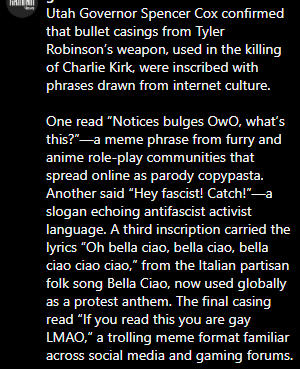
The immediate claim I have decided, in order to be as up to date as possible, involves the murder of Charlie Kirk. This is a hot button issue, with the balance between “people shouldn’t just be shot” and “Kirk was on record for saying incredibly bigoted things several times throught his life and career, we don’t have to posthumously declare him a saint”. For now, I will be focusing specifically on the messages written on the bullet and the political implications therein.
To illustrate, I will be using the SIFT process to analyze this news and evaluate it’s veracity.
STOP: I am quite aware of the Charlie Kirk situation overall, as it is fairly recent. In addition, this is a news site-that doesn’t make it inherently trustworthy, but it does provide a base.
I went to investigate the site, analyzing it’s specific features, what sets it apart from other news sites. Groundnews prides itself on something it calls Blindspot, examining how a story is presented from political angles and examining/highlighting how certain sides of a story are ignored due to a lack of coverage. It also provides breakdowns on Left/Center/Right coverage of stories. This shows a dedication to neutrality-which one could consider an agenda of it’s own, but I digress.
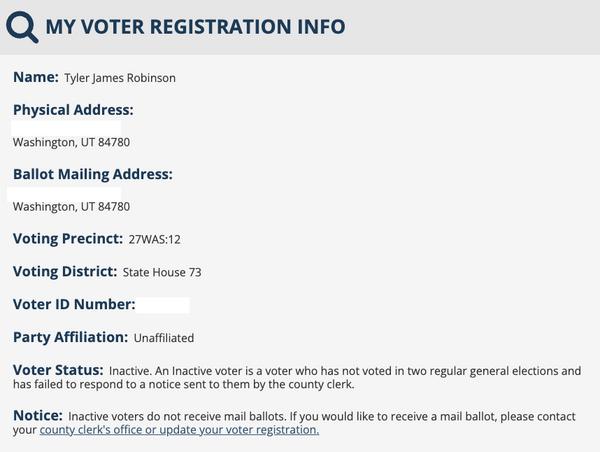
While I could not find any specific fact checking on the bullet contents or any political beliefs outright stated by current suspect Tyler Robinson (who I will not say outright is or is not the culprit until further evidence is posted), I was able to find a point stating that while Robinson’s family were registered Republicans, Robinson himself did not register a party when he registered to vote.
TRACE:
This image was placed on the Snopes page I have already linked, (with some minor redaction for privacy reasons for Robinson and his family). Government records aren’t easily falsifiable, so I’m inclined to believe this.
So after all of this, we come to a soft conclusion: I did not find direct evidence of the bullet message specifically, but I did find context. And this is still an ongoing development, fairly recent: I can check again in the near future to see if more information comes out.
The point of this is to illustrate that when an event is recent, it can be tricky to find direct confirmation or denial of something. You must always keep checking and chipping away at it until something gives-journalism isn’t always about Big Scoops that Blow A Case Wide Open. Sometimes, it’s about the gradual work that slowly uncovers truths as FOI-Acts and investigations come up. Slow and steady wins the race, so goes the story of the tortoise and the hare.
RumorGuard is a news/information service provided by News Literacy Project. In addition to a feed of recent events that explains why and/or how they’re misinformative (whether that be through AI-generated images and video or more old-school techniques like straight up lying), it also contains tools and tips for spotting misinformation, with PDFs and video lessons. There’s also a simple set of ‘how you can help’ areas, with donations and asks for assistance.
It’s pretty comprehensive, even if the site itself admits that it’s a beta. It explains and gives tools for how to spot it on your own, while consistenly providing a good stream of fact checking for those who want examples or just a deeper dive than what they’re personally capable of. I think this is a good resource to send someone who’s on the fence about certain topics. It is fundamentally, however, just a basic database with some reading and videos to help explain what’s going on. It’s not really interactive in any way other than simply being a website, unlike the other half of what I went over today.
Bad News (or getbadnews.com) meanwhile plays more like a game, a short visual novel walking you through the process of how a single person or a small team can create polarizing drama and sensational nonsense, with a final score to evaluate how good you were at picking the ‘right’ options represented by Twitter followers (or, X now. Someone should update that.). The interactive element does make it more compelling than RumorGuard: We like to play games! It’s literally in our genetics, if you read the homo ludens theory. But it also makes it more effective as a teaching tool: playing with material hands on like this creates a stronger memory than simply being told about how something works. Muscle memory is more effective than regular memory, after all.
Which is why I think an interactive experience is much better for illustrating the points provided about how something works. By giving you a hands-on experience with the material-making fake news and giving you concrete feedback in terms of what works and what doesn’t, it allows for more solid feedback that sticks in your mind in a way that reading or listening, slightly more ‘passive’ experiences compared to doing, doesn’t. I would still recommend RumorGuard because it has ongoing coverage of actual news stories that you can check if you yourself are unsure. Giving someone the tools to do something is good, but it never hurts to be able to double check a reliable source to make absolutely sure that something is real or false. But overall, games like Bad News are something I would highly recommend to teenagers learning about misinformation for the first time, to help them understand what in the world is just being used to make them angry or scared, and to give thm the tools to understand and counteract mis- and dis-information in their lives.
11:30: Wake up. Check my usual websites that I spend a good chunk of time on to see what’s new: Bluesky, Youtube, Discord, Sufficient Velocity, Something Awful. Usually for those sites I’m already subscribed or following people that I check in on, from Let’s Players to video essayists to online CYOAs. I’m not looking for ‘new information’, but updates on ongoing things.
12:45-ish: Fell down a fascinating rabbit hole of a new Youtuber I found named Deckard (https://www.youtube.com/@deckardv) who covers the associations people have between things like, say months or school subjects and colors. He does his own polling and data and breaks it down quite thoroughly with graphs and statistics, which makes me trust his methodology, even if only polling his own viewers means that his data is still somewhat limited.
3:00: Go with my parents to see my sister at a volleyball game she’s playing in a different town. Spend most of the trip listening to music on my phone, a mix of video game music and pop stuff. I’m listening to a lot of Chappell Roan now.
5:00: Watch my sister at the volleyball game. There’s not a lot of ads inside the gym in question, and so I listen to some more video essays on my phone (thanks to another youtuber I recently discovered named Mark’s Rec Room, https://www.youtube.com/@marksrecroom ). The essays are mostly reviews, and you can’t exactly ‘fact check’ opinions on video games, so I broadly take his points at face value, given that he doesn’t say anything that seems off.
9:30 PM: Check Bluesky again, this time focusing on the posts of one of the people I follow on Youtube, Todd In The Shadows (https://bsky.app/profile/shadowtodd.bsky.social). Most of it’s self-promotion for his Youtube Channel, the podcasts he hosts, cute dog picks and occasional one-sentence pseudo reviews or random thoughts. Obviously, someone who makes money off of those things needs to promote them, but he’s never obnoxious or desperate about his promotion, and he’s got a casual laid back vibe and has never said anything super rancid. I go to bed around 2 in the morning.
Overall, admittedly I spend a lot more time reading/listening to ‘opinion’ work, which is hard to fact check than news or stories. Obviously that doesn’t make it free from criticism, but my news tends to come from family members and people in my friend circle, who aren’t ‘media’. They filter things somewhat. Obviously, people still have personal biases that can alter things. If my parents say something just a hair off color, I try to check it. But I would say that overall, I don’t encounter outright lies often. But maybe that just says a lot about how good my adblocker is and how I don’t care for the Republican party.
Hi, my name is Connor Herron, and I’m a big fan of all types of music, especially pop music. In this space, I’ll be bringing you my thoughts and analysis on big sounds in music, from the most recent stuff to older sounds. I hope you enjoy it, and I look forward to bringing you into my world and showing my opinions to all of you.